
IN A NEW LIGHT
On Pasadena, honoring a legacy of style & finding inspiration close to home.

My husband, Greg, and I moved to our current house in the spring of 2015. Not only was it three times the size of our previous home, it was Greg’s grandparents’ house from 1952 to 1972, and so it carried with it the weight of history and deep sentiment. He came home from the hospital here as a baby. The echoes of his childhood, raucous holiday parties, long summer afternoons rang through every room, every hidden corner. – Todd, from Golden Light
We spend much of our time looking outward — traveling, sourcing, pouring over well-worn design books — but often we find that the spaces we inhabit every day are the most revealing. Todd and Greg’s house in Pasadena, in its many roles as home, party host, and backdrop for product shoots, has continued to show us how history and architecture shape one’s mood, and how details, even something as quiet as a light fixture, can influence the way we experience a room.
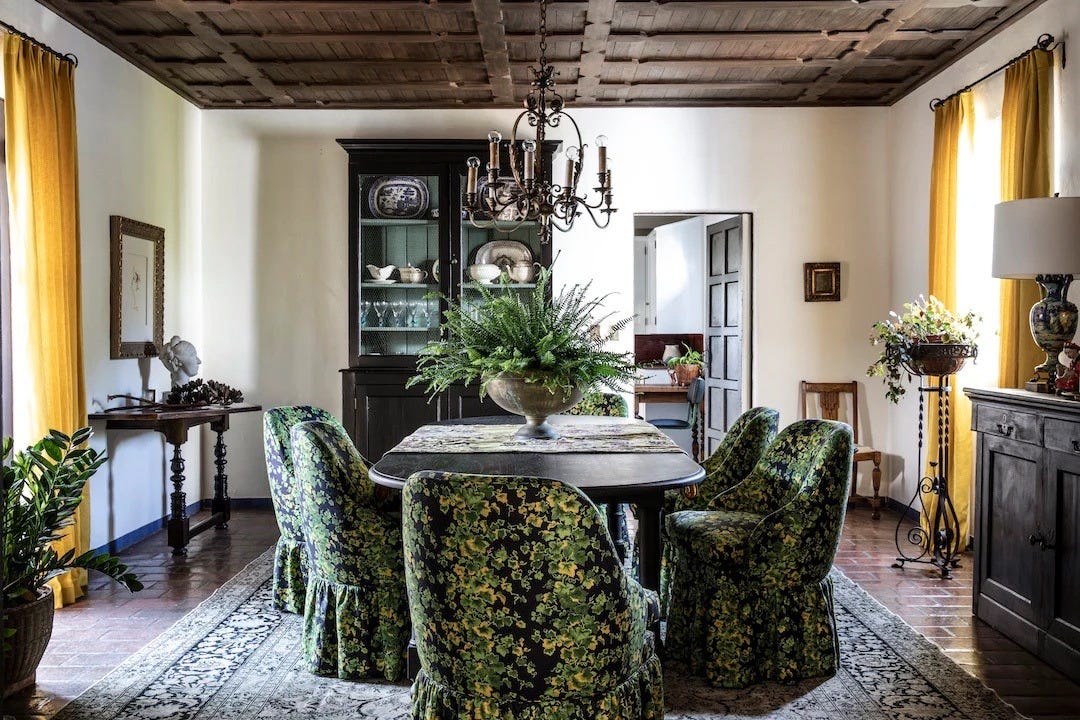
Pictured above: The dining room of Todd and Greg’s home. The Cove Dining Chairs from our Collection are upholstered in Gert Voorjans Day & Night fabric. Photographed by Amy Neunsinger
Pasadena emerged in the early 20th century as a national center of Arts and Crafts residential design and remained at the forefront of architectural innovation through 1942. During this Period Revival era, an affluent population, rapid growth, and highly trained architects made Pasadena a hub for evolving California styles. Designers interpreted national and regional precedents, drawing on the Arts and Crafts philosophy of reimagining classical elements for contemporary needs.
Residential development unfolded in two phases: pre-1925 construction favored Colonial forms, while the following fifteen years leaned toward European influences — England, Spain, Italy, and France — eventually giving rise to the California Ranch style. Spanish Revival, inspired by the 1915 Panama-California Exposition designed by Bertram Goodhue, became a defining motif. The style blended Mediterranean sources into increasingly imaginative compositions and was adopted across Southern California for single-family homes and entire districts.
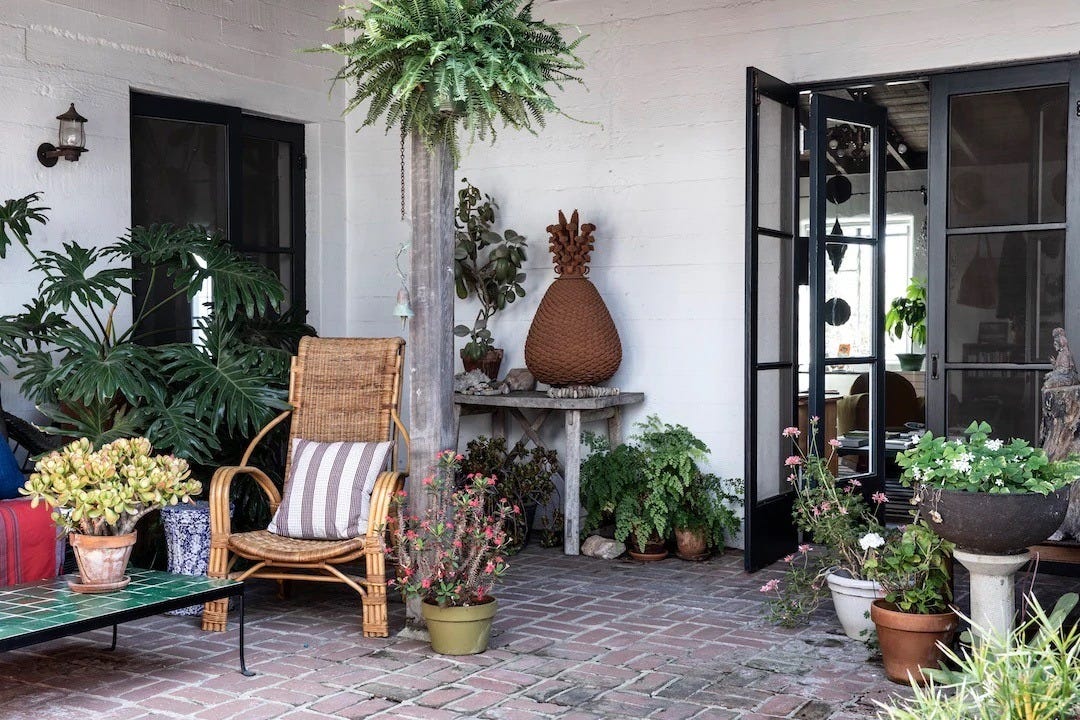
Pictured above: Todd & Greg’s home’s informal layout around a central courtyard is a reference to traditional haciendas that focused inward and were expanded as needed over time. Photographed by Amy Neunsinger
Todd and Greg’s home was designed and constructed by William F. Staunton, Jr. in the 1920s, who finished the house with traditional details and materials — arcades, corredors, ironwork, tile floors and murals, paneled wood doors and open-beam ceilings — of fine quality and execution, yet maintained an overall simplicity and rustic appeal that is closer in spirit to the real Spanish missions and ranchos than some of the grander and more elaborate examples of the Spanish Revival style. It is this combination of finesse and simplicity that makes the home a distinctive example of Spanish Revival architecture in Pasadena.
The home was designated as a historical landmark by the Pasadena Historic Preservation Commission in 2021, and is formally known as the William F. Staunton, Jr. Residence.
The Staunton Residence was designed by the architectural firm Webber, Staunton & Spaulding as the family residence of partner William F. Staunton. The firm was among the most prominent in Los Angeles in the 1920’s and executed a number of high-profile commissions in and around the city. exhibiting a great degree of design skill in various revival styles as well as the emergent Art Deco. These included the Malaga Cove Plaza in Palos Verdes Estates (1922-24) and the Catalina Casino (1928) in Avalon. The firm also designed a number of private residences, apartment buildings, schools, and commercial buildings in the Los Angeles area.
Staunton, his wife Mary, and their two children occupied the home until 1940 when they sold the property to the owner of a Dodge dealership and his wife. It was later sold in 1956 to television newscaster, and Greg’s grandfather, Grant Holcomb Jr. and his wife Jeanne, who moved into the house with their three children.
Grant and Jeanne sold the property in 1972 to physician and research scientist Marylou Ingram who lived there until her death in 2013. In 2015, the Staunton Residence was purchased from Dr. Ingram’s estate by Todd and Greg.
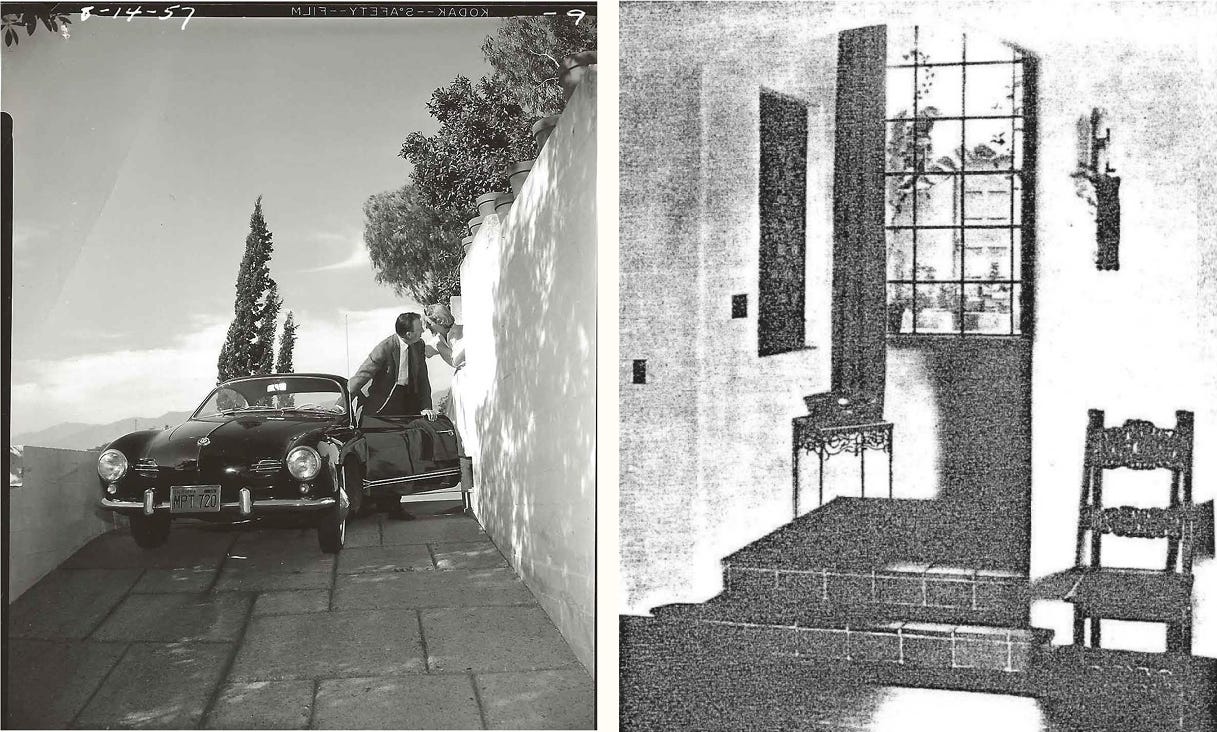
Pictured above: LEFT - Grant & Jeanne Holcomb on the driveway of the Staunton Residence, 1957. RIGHT - The living room photographed in 1931 by Miles Berné of California Arts & Architecture
Our homes, their quirks, patina, and lived-in character, have a way of quietly shaping how we see. They remind us that design isn’t static, it’s something that deepens and evolves with time, use, and care. The details that surround us at home often become the foundation for what we create, a reflection of how light moves through a room, how materials age, or how a space makes us feel.
Living in a historic home like the Staunton Residence has a way of slowing the eye. Our time here has deepened our understanding of how architecture can shape a mood, and how a house can become a conversation with the past. The materials and proportions hold a reminder that thoughtful design endures.
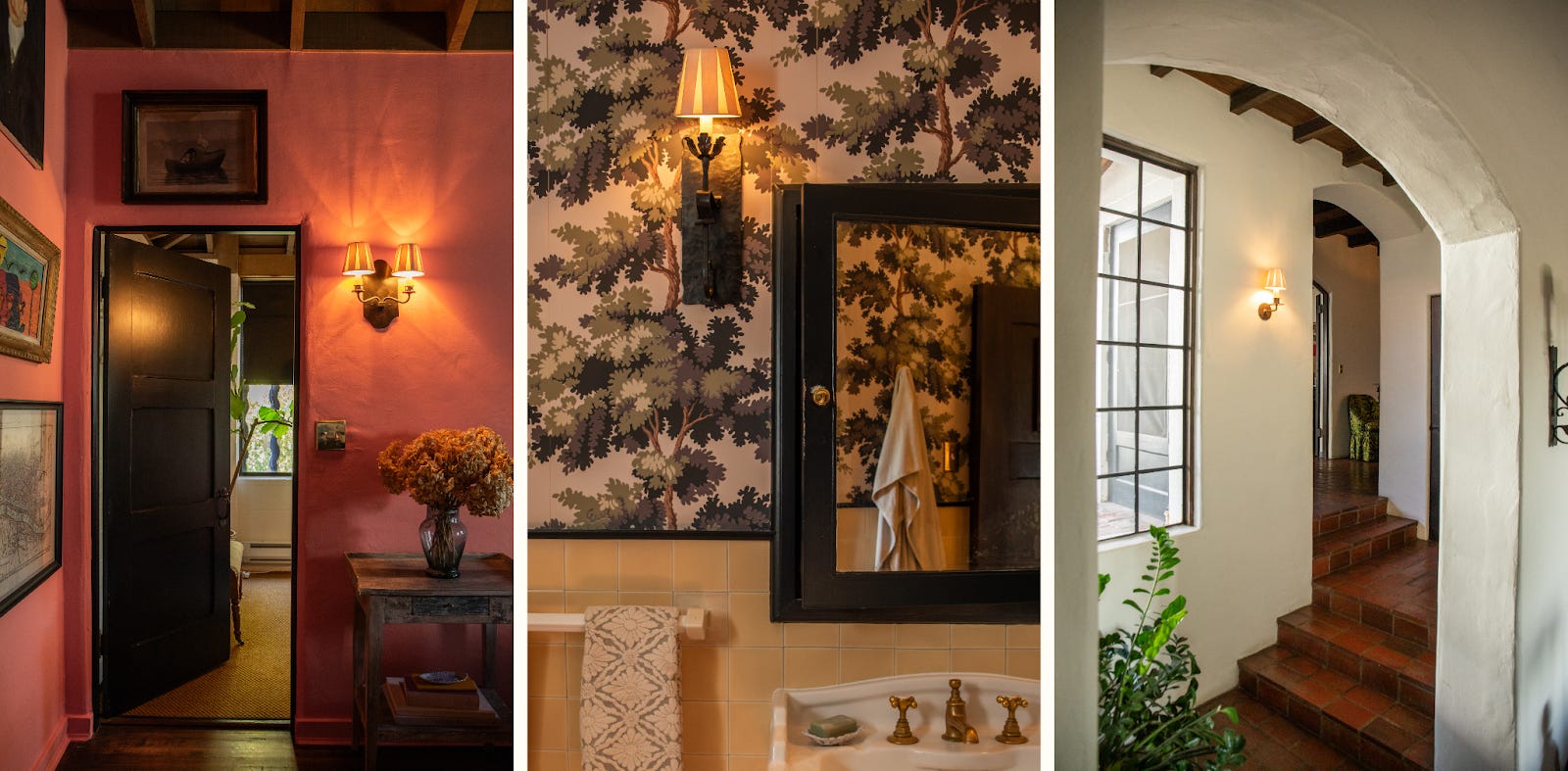
Pictured above: Our Grant, Jeanne, and Patrician sconces from the Nickey Kehoe Collection, photographed in Todd and Greg’s Pasadena home.
The lighting, in particular, has always felt like an important thread of inspiration. The original sconces, with their rugged simplicity and gentle elegance, capture what we love most about the house itself — grounded, functional, and beautiful in restraint. The same spirit carries through the original hardware, still working perfectly after nearly a century. These details, humble yet refined, have influenced so much of our approach to design and how we think about the relationship between form and feeling.
Our beloved Patrician Sconce, and now our latest Grant and Jeanne Sconces were born from that inspiration. Named for Greg’s grandparents, they echo the enduring sensibility of the home — sturdy, soulful, and made to last. In them, we hope to capture not only the look of the original fixtures but the atmosphere they’ve long created, the soft, golden light that’s illuminated this house for generations.

Pictured above: Our Grant and Jeanne Sconces from the Nickey Kehoe Collection, now available at nickeykehoe.com
For us, the pieces we create for Nickey Kehoe represent more than function, they’re a continuation of the stories that shape us. Every object we create is an invitation to build upon what came before: to honor the craftsmanship of the past while making room for new life to unfold. The Grant and Jeanne Sconces, like the house that inspired them, are a reminder that beauty lives in things made with care, and that the light of history still has the power to warm the present.
Thanks for stopping by! See more of what we’re up to by subscribing to our Substack below, following along on Instagram, and visiting us at nickeykehoe.com
Wonderful article. I wanted to write one about your house and call it "Home Again."
I love this so much, it’s such a special place! ❤️❤️❤️